










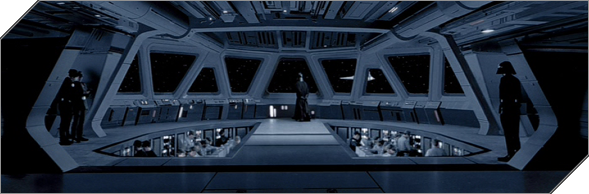




The history of the Galactic Empire is inseparable from the history of the Galactic Republic. For more than twenty-five millennia, the Republic stood as the greatest political union the galaxy had ever known. It connected countless worlds through common law, trade, diplomacy, and mutual defense. Kingdoms, democracies, principalities, corporations, and planetary federations all found representation beneath the dome of the Galactic Senate.
Yet no government, however ancient or celebrated, remains unchanged forever. Over the centuries, the institutions of the Republic became increasingly distant from the people they were intended to serve. Political influence concentrated in the hands of wealthy Core Worlds, powerful commercial interests, and entrenched Senatorial families. Bureaucratic delays frustrated entire sectors. Corruption became commonplace. The central government demanded loyalty from its member worlds while proving increasingly unable to guarantee security, justice, or meaningful representation.
By the final years of the Old Republic, the great beacon of galactic civilization had become a shadow of its former promise.
Prior to BIA 10 • An ancient government in decline
The Galactic Republic was founded as a bastion of civilization, cooperation, and law. For thousands of years, its institutions helped prevent large-scale conflict between its member worlds and provided a forum through which disputes could be resolved without war. Its longevity, however, became one of its greatest weaknesses.
The Senate grew unwieldy as the Republic expanded. Representatives became increasingly disconnected from the systems and populations they claimed to serve. Wealthy sectors and commercial interests used influence, patronage, and procedural obstruction to protect their own advantages. Essential legislation could be delayed for years, while petitions from distant worlds disappeared into committees and bureaucratic offices on Coruscant.
The Republic's military strength had also declined. Following centuries of reform and demilitarization, the central government maintained little more than the Judicial Forces, sector defense agreements, and a collection of ceremonial or locally controlled military units. The Judicial Forces could suppress piracy, enforce federal warrants, and intervene in limited disputes, but they were never intended to fight a galaxy-wide war.
Discontent was especially strong in the Mid Rim, Outer Rim, and among worlds that believed themselves exploited by Core-based institutions. Some sought greater autonomy. Others demanded commercial independence, military self-determination, or complete withdrawal from the Republic.
Thousands of systems eventually rallied around former Jedi Master Count Dooku and the newly formed Confederacy of Independent Systems. Although many Separatist worlds possessed legitimate grievances, their movement increasingly depended upon the immense resources of corporate powers, private military suppliers, mercenary commanders, and automated armies.
The Trade Federation, Techno Union, Commerce Guild, Corporate Alliance, and InterGalactic Banking Clan pledged their resources to Dooku's cause. Their factories and treasuries gave the Confederacy access to fleets, weapons, and an immense army of battle droids. General Grievous became the most feared commander of this growing military.
The crisis had passed beyond politics. The galaxy stood on the threshold of civil war.
BIA 10 • Kamino, Geonosis, and the creation of the Grand Army
The Republic possessed no military comparable to the forces gathering under Dooku. Debate over the proposed Military Creation Act divided the Galactic Senate. Supporters argued that the Republic needed an army to confront the growing threat. Opponents feared that creating such a force would make war inevitable and place dangerous powers in the hands of the Supreme Chancellor.
Senator Padmé Amidala of Naboo became one of the measure's most prominent opponents. She believed the crisis could still be resolved through negotiation and warned that militarization would destroy any remaining hope of reconciliation.
An attempt on Amidala's life changed the course of galactic history.
Jedi Knight Obi-Wan Kenobi was assigned to investigate the assassination attempt. His search led him beyond the Republic's conventional star charts to the remote world of Kamino. There, Kenobi discovered that the Kaminoans had spent nearly a decade producing an army of genetically engineered clone soldiers.
The army had apparently been commissioned in the name of the Republic by Jedi Master Sifo-Dyas, who had died shortly after the Battle of Naboo. The Jedi Council had neither authorized the order nor known of its existence.
The clones had been created from the genetic template of the Mandalorian bounty hunter Jango Fett. They were bred for discipline, unit cohesion, physical endurance, and rapid battlefield adaptation. Accelerated aging allowed them to reach military maturity in approximately half the time required by natural-born Humans. Their training had prepared them to fight as a unified galactic army.
Their origin remained deeply troubling. Sifo-Dyas had long believed that a great war was approaching and had unsuccessfully urged the Jedi Council to prepare for it. Whether he had acted entirely alone could not be established. The circumstances surrounding his death, the selection of Jango Fett, and the financing of the Kaminoan project remained shrouded in uncertainty.
Kenobi traced Fett from Kamino to Geonosis, where Count Dooku had gathered the leaders of the great commercial powers. There, Dooku revealed the military foundation of the Confederacy. Geonosian foundries were producing vast numbers of battle droids, while corporate leaders pledged their armies and fleets to the Separatist cause.
Kenobi transmitted his discovery to the Jedi Council but was captured before he could escape. Anakin Skywalker and Senator Amidala attempted to rescue him and were themselves taken prisoner. Dooku ordered all three executed in the Geonosian arena.
A Jedi strike force led by Master Mace Windu arrived to free the captives and arrest the Separatist leadership. The intervention became a battle for survival as overwhelming numbers of battle droids surrounded the Jedi. For generations, the Jedi had served the Republic as negotiators, investigators, and peacekeepers. On Geonosis, they entered a war.
News of the Separatist army threw the Senate into panic. With Senator Amidala absent, Representative Jar Jar Binks of Naboo proposed that Supreme Chancellor Palpatine be granted emergency powers to respond to the crisis. The Senate approved the motion.
Palpatine used his new authority to formally create the Grand Army of the Republic and authorize the deployment of the clone forces discovered on Kamino. Grand Master Yoda traveled to Kamino and brought the first formations to Geonosis. Their arrival prevented the destruction of the surviving Jedi and transformed the attempted rescue into the first major battle of the Clone Wars.
Clone gunships descended into the arena. Republic walkers advanced across the Geonosian plains. Newly commissioned warships engaged the Separatist fleet above the planet. The Confederacy's leaders escaped, but their armies had been exposed.
The Republic had acquired the military force it desperately needed. The price was war.
BIA 10-7 • The first three years of war
The Battle of Geonosis marked the beginning of open hostilities between the Republic and the Confederacy. The newly formed Grand Army performed with extraordinary effectiveness. Clone formations that had never before experienced combat fought with discipline and coordination against numerically superior droid forces.
Their intervention saved much of the Jedi strike force and forced the Separatist leadership to abandon Geonosis. The battle was nevertheless far from a complete Republic victory. Count Dooku escaped. The principal members of the Separatist Council survived. Much of the Confederate fleet withdrew successfully, carrying the war to systems throughout the galaxy.
The clones became the professional core of the new Grand Army. They served beneath Jedi Generals, with experienced clone commanders providing the military discipline necessary to translate Jedi strategy into battlefield operations. Judicial officers, local defense personnel, and volunteers from Loyalist worlds also entered Republic service, although clone formations initially carried the greatest burden of the fighting.
The Jedi Order accepted command reluctantly. For thousands of years, the Jedi had worked to prevent conflict and mediate disputes. They possessed courage, discipline, and remarkable abilities, but most had little experience commanding armies or conducting campaigns across entire sectors.
The transition altered the Order profoundly. Knights became generals. Padawans became commanders. Children trained to understand the Force were sent into battle beside soldiers bred for war.
The Confederacy had prepared for war more thoroughly than the Republic. Separatist factories could produce battle droids in enormous quantities. Corporate fleets provided warships, transports, and logistical support. Entire systems joined the movement after Geonosis, whether from ideological conviction, fear of Republic retaliation, or the expectation of commercial advantage.
Fighting erupted at Christophsis, Ryloth, Muunilinst, Mon Cala, Felucia, and throughout the Outer Rim. Worlds far removed from the original dispute found themselves forced to choose between the Republic and Confederacy. Some campaigns ended in decisive victories. Others became prolonged struggles in which planets changed hands repeatedly.
General Grievous emerged as the most feared commander of the Separatist military. Trained in lightsaber combat by Count Dooku and commanding forces of overwhelming size, Grievous waged war with little concern for civilian life. His campaigns destroyed Republic fleets, shattered planetary defenses, and forced the Jedi to spread their remaining strength across an ever-expanding front.
The Republic responded by accelerating clone production, nationalizing strategic industries, coordinating sector fleets, and expanding the emergency authority of the Supreme Chancellor. Measures intended to last only for the duration of the crisis became permanent features of government.
Even during these early years, the limitations of the Republic war effort were becoming clear. Clone forces were formidable but finite. Judicial ships had never been designed to sustain a galactic conflict. Planetary defense forces varied greatly in quality, equipment, and willingness to serve beyond their home systems.
Initial predictions that the conflict would be resolved quickly proved unfounded. For three years, the Republic and Confederacy bled one another across thousands of worlds.
Then General Grievous brought the war to Coruscant.
BIA 7 • A decisive Republic victory won at terrible cost
General Grievous launched a daring assault against the galactic capital, breaking through Republic defenses and striking directly at the heart of the government. During the attack, Confederate forces captured Supreme Chancellor Sheev Palpatine and transported him aboard Count Dooku's flagship, the Invisible Hand.
Jedi Generals Obi-Wan Kenobi and Anakin Skywalker led the rescue operation. Supported by clone pilots and commandos, the two Jedi boarded the Confederate flagship and fought their way toward the Chancellor while the battle raged around them.
Count Dooku confronted Kenobi and Skywalker near the vessel's command levels. The duel ended with Dooku's death, depriving the Confederacy of its political leader. General Grievous then attempted to prevent the rescuers from reaching Palpatine. In the fighting that followed, Grievous was killed by the combined efforts of Kenobi, Skywalker, and the clone commandos accompanying them.
The deaths of Dooku and Grievous should have broken the Separatist war effort. Instead, the rescue became a catastrophe.
The Invisible Hand had suffered critical structural damage during the battle. With much of its command crew dead and its control systems failing, the warship entered Coruscant's atmosphere. Kenobi and Skywalker attempted to guide the shattered vessel toward an emergency landing while clone personnel evacuated Palpatine from the detention area.
The ship broke apart during descent and struck Coruscant's urban sprawl in an immense explosion.
Supreme Chancellor Sheev Palpatine was killed. Anakin Skywalker and Obi-Wan Kenobi were killed. Thousands of Republic and Confederate personnel died with them.
Millions witnessed the destruction from across the galaxy. In a single battle, the Republic lost its head of government and two of its most celebrated heroes. The Confederacy lost both its political leader and its supreme military commander.
The Republic retained Coruscant and forced the Confederate fleet to withdraw. It had won the battle, but the price was almost incalculable. The deaths of Palpatine, Kenobi, Skywalker, Dooku, and Grievous deprived both governments of the leaders who had directed the war from its beginning.
The Battle of Coruscant did not end the Clone Wars. It transformed them. Thereafter, victory would depend less upon celebrated individuals than upon institutions, industry, logistics, and endurance.
Palpatine had served as the Republic's political anchor throughout the crisis. Dooku had held together a Separatist movement composed of governments, corporations, revolutionaries, opportunists, and military factions with widely different ambitions. Grievous had imposed a measure of unity upon their armed forces through fear and ruthless discipline.
Without them, both governments entered a period of confusion. The Republic still possessed the Senate, the courts, its military command structure, and the legitimacy of an ancient government. The Confederacy retained its armies, industrial base, occupied territories, and a dispersed network of military councils and corporate commanders.
Commanders on both sides began acting independently while political leaders struggled to establish new authority. The war entered a second phase, less coordinated than the first and far more destructive.
BIA 7-1 • Seven more years of conflict
Following Palpatine's death, the Galactic Senate elected Kor'vas Or'kee of Bothawui as Supreme Chancellor. Or'kee was an experienced and calculating politician known for his connections to Bothan intelligence networks. He promised to preserve the Republic, restore stability, and bring the war to a decisive conclusion.
Instead, he inherited a divided Senate, an exhausted military, and a deteriorating economy. With Dooku and Grievous both dead, the Confederacy splintered into competing political and military factions. Corporate councils, sector commanders, local governments, and ideological hardliners continued the war for different reasons and often ignored one another's authority.
The loss of central Confederate leadership did not immediately produce collapse. It transformed a coordinated rebellion into a sprawling collection of wars, occupations, sieges, and insurgencies. The Republic could defeat individual armies while still failing to end the conflict as a whole.
The result was a grinding stalemate. The Clone Wars continued for another seven years.
One of the first great crises of Or'kee's administration came at Ord Mantell. The world housed a major Judicial Forces arsenal, extensive military infrastructure, and supply depots vital to Republic operations throughout the Mid Rim.
A coalition of Separatist commanders launched a coordinated offensive against the planet, combining battle-droid armies with mercenaries, local insurgents, and heavy orbital support. The existing Judicial garrison resisted fiercely but could not contain the assault alone.
Command of the Republic naval relief force was entrusted to Commander Draco Tanos of Jaminere, a veteran Judicial Forces officer whose service dated to the Stark Hyperspace War. Although respected within military circles, Tanos remained little known to the wider Republic.
Rather than commit his entire force to a single frontal engagement, Tanos divided the relief fleet into several independent task groups. Using secondary hyperspace approaches, coordinated feints, and close cooperation with local defense forces, he compelled the Separatist commanders to disperse their strength across several threatened routes.
The maneuver allowed Republic reinforcements to break through the blockade and restore contact with the besieged garrison. Clone formations, Judicial units, and Loyalist planetary troops then fought as a unified force beneath a common operational plan. The Republic retained the principal arsenals, though much of the surrounding territory was devastated and several major supply complexes were destroyed.
The Relief of Ord Mantell became the Republic's first major strategic victory following the disaster at Coruscant. It restored public confidence in the war effort and brought Tanos to the attention of the Senate, High Command, and Chancellor Or'kee.
More importantly, the campaign demonstrated that clone commands, Judicial units, sector fleets, and planetary forces could be integrated into a single military system. Although the Republic Army and Navy would not be formally restored until later, many Imperial historians regard Ord Mantell as the birth of the unified doctrine that eventually shaped the Imperial Armed Forces.
Kamino's cloning facilities struggled to meet the Republic's growing demand for soldiers. Separatist sabotage disrupted production and supply, while accelerated growth cycles could not be shortened indefinitely without compromising the health and training of the troops.
The clones remained disciplined and reliable, but they could not be produced quickly enough to replace every loss, occupy every liberated world, or defend every threatened route. The Republic therefore expanded the recruitment of natural-born soldiers. Volunteers from Loyalist systems entered federal service. Planetary defense forces were nationalized or placed under Republic command. Sector fleets were integrated into larger strategic formations.
By the final years of the war, clones remained the elite professional core of the Republic military, but natural-born personnel supplied most of its total manpower. Clone officers served beside recruited soldiers and sailors, Judicial commanders transitioned into conventional military roles, and planetary units adopted common doctrine and equipment standards.
The prolonged war claimed many figures who had once represented hope for a peaceful resolution. Grand Master Yoda died defending Kashyyyk from a massive droid invasion.
Senator Padmé Amidala, former Queen of Naboo and one of the Senate's most prominent advocates for peace, was assassinated by Separatist agents during a diplomatic mission to Rodia.
The liberation of Mandalore became one of the most difficult campaigns of the war. Republic forces and Loyalist Mandalorians fought street by street against Darth Maul's Shadow Collective and the clans that remained loyal to him.
Ahsoka Tano, once the Padawan of Anakin Skywalker, returned to military service during the siege and helped coordinate the advance upon Sundari. Jedi Master Mace Windu joined the final assault against the capital and confronted Maul within the royal district.
Windu succeeded in killing Maul, but suffered mortal wounds during the fighting and died before the city was fully secured. His sacrifice broke the Shadow Collective's leadership and allowed Loyalist forces to complete the liberation of Mandalore.
Ahsoka Tano disappeared during the closing stages of the campaign. Although many believed that she had died amid the destruction of Sundari, no body or conclusive evidence of her fate was ever recovered.
By the closing years of the war, the Jedi Order had been reduced to a shadow of its former strength. Only a few hundred Knights and Masters remained. Temples had been destroyed, archives lost, and generations of students sent into battle before their training could be completed.
BIA 6-1 • The return of the Army and Navy
As the conflict continued, veterans of the Judicial Forces argued that the Republic could no longer rely upon temporary formations and emergency command arrangements. Among the strongest advocates were officers who had served during earlier crises, including the Stark Hyperspace War.
They petitioned the Senate to formally restore the Army and Navy of the Republic. The proposal called for the nationalization and consolidation of clone formations, Judicial Forces, sector fleets, and planetary defense units. Rather than existing as a collection of overlapping organizations, the Republic military would become a permanent institution under a unified High Command.
The Senate eventually approved the reforms. The Republic Army and Republic Navy were reborn.
This restructuring improved coordination across the front. Standardized logistics reduced supply shortages. Sector forces gained access to central intelligence and strategic planning. Republic fleets could finally operate across multiple theaters without relying entirely upon local command arrangements.
Following his victory at Ord Mantell, Draco Tanos received promotion and increasingly important commands. His earlier service in the Judicial Forces and experience during the Stark Hyperspace War had prepared him to work across the institutional divisions that hindered the Republic war effort.
During the Tion Campaigns and operations along the Corellian Run, Tanos expanded the methods first demonstrated at Ord Mantell. His task forces combined clone formations, Republic naval personnel, local defense units, and Loyalist resistance movements beneath unified commands capable of operating independently for extended periods.
His victories reopened vital hyperspace lanes, relieved isolated Loyalist worlds, and helped establish the strategic momentum that eventually carried the Republic to Raxus. By the closing years of the war, Tanos had become one of the most respected officers in the Republic Navy.
BIA 1 • The fall of the Confederacy and the surrender of Raxus
The Clone Wars lasted for a total of ten years. By the end, entire regions of the galaxy had been devastated. Some worlds were depopulated through chemical or biological warfare. Others were reduced to slag by sustained orbital bombardment. On a small number of planets, atmospheric ignition and ecological collapse rendered the surface effectively uninhabitable.
Trade routes had been severed. Planetary economies had collapsed. Refugee populations numbered in the billions. The Confederacy fractured beyond recovery as its member states exhausted their armies and treasuries. Corporate leaders attempted to preserve their remaining assets, local commanders ignored political authorities, and ideological hardliners continued fighting long after victory had become impossible.
Republic forces gradually isolated the remaining Confederate regions. Some Separatist governments negotiated local armistices. Others were overthrown by their own populations or abandoned by the corporate armies that had sustained them. Several military leaders escaped into the Outer Rim, where they later formed the nucleus of holdout and insurgent movements.
The Republic launched its final campaign against Raxus, the capital of the Confederacy of Independent Systems. Republic forces surrounded the world and imposed a siege. Food, fuel, and military supplies dwindled. The Separatist Congress, abandoned by many of its most powerful supporters and facing starvation, voted to surrender.
The surrender did not result in a single universal settlement. Political delegates, military commanders, corporate sponsors, and local officials were judged separately. Some received amnesty in exchange for disarmament and renewed allegiance. Others faced prosecution for atrocities, piracy, or the unlawful use of prohibited weapons. Many corporate interests surrendered assets or accepted Imperial supervision in order to continue operating.
After ten years of war, the Clone Wars ended. The Republic had survived. The galaxy it governed had not.
BIA 1 • The ravaged Republic and the Chancellor's Tribunal
The end of the war brought relief, but not stability. Countless worlds required reconstruction. Refugees crowded ports and temporary settlements. Veterans returned to societies unable to support them. Industries built around wartime production faced sudden collapse, while other industries had been destroyed entirely.
Former Separatist worlds feared punishment or occupation. Loyalist worlds demanded compensation for years of sacrifice. Military officers warned that Confederate holdouts remained active across the Rim. The Republic's institutions were strained beyond anything they had been designed to endure.
Supreme Chancellor Or'kee had remained in office throughout the conflict. By the end of the war, he had served for eleven and a half years, far longer than permitted by the Constitution. His continued tenure had originally been justified as a wartime necessity. Peace removed that justification, but Or'kee did not surrender his accumulated power.
Seeking to direct public anger away from his administration, Or'kee created the Chancellor's Tribunal for Crimes Against the Republic. The tribunal was presented as a war crimes court intended to prosecute those responsible for atrocities committed during the Clone Wars. Many citizens initially welcomed the announcement.
The Tribunal, however, answered only to the Chancellor. It was independent of the Supreme Court, possessed no meaningful Senatorial oversight, and operated through anonymous judges and secret proceedings.
Concerns became outrage when the Tribunal released the names of its first ten defendants. Every one of them had served in the Republic Army, Republic Navy, or Loyalist resistance movements. No major Separatist commander appeared on the list.
Or'kee defended the decision as necessary to heal the wounds of a divided Republic. His critics accused him of sacrificing Republic war heroes to appease former Separatist interests and strengthen his own control. Protests erupted across the galaxy.
The military High Command and Republic Security Council remained publicly silent. Privately, confidence in the Chancellor collapsed.
Admiral of the Fleet Draco Tanos, then serving as Naval Chief of Staff, ordered the removal of Senate Guard officers and commandos from his Victory-class flagship. The order included members of his own honor guard, provided through his position on the Security Council. Tanos encouraged other naval commanders to take similar precautions.
Many Senators filed petitions with the Supreme Court seeking an injunction against the Tribunal. Others demanded the immediate release of the accused. The Republic was again approaching civil conflict.
BIA 1 • Or'kee moves against the military
On the advice of Naval Chief of Staff Tanos, the Security Council ordered the fortification of the Coruscant system and strengthened defenses on Coruscant itself. The stated purpose was to preserve public order and protect the government during the growing crisis.
Chancellor Or'kee interpreted the action as preparation for a military seizure of power. He ordered the demobilization of a large portion of the armed forces and pressured several prominent officers into retirement, including the Army Chief of Staff and the Chief of the Defense Staff.
Or'kee then appointed Draco Tanos as Chief of the Defense Staff. The appointment was not intended as a promotion. By removing Tanos from direct command of the Navy, Or'kee hoped to weaken his influence over naval officers. The Chancellor replaced him as Naval Chief of Staff with a political loyalist from Bothan Space.
The maneuver failed. Tanos now held legal command authority over the entire Republic military.
The crisis reached its breaking point with the trial of General Nottap of Corellia. Nottap was widely credited with preserving the Corellian Sector during the war. He was a decorated officer, a popular figure among veterans, and a symbol of Corellian resistance to the Confederacy.
His trial lasted only three hours. The Tribunal declared him guilty.
The verdict was followed by a second list of Republic officers scheduled for arrest and prosecution. Public confidence in the government collapsed. Corellian leaders openly condemned the Chancellor. Military commanders questioned whether they could lawfully obey orders from an administration using secret courts to prosecute its own defenders.
The Republic stood on the edge of another civil war. Draco Tanos decided that he could no longer remain neutral.
BIA 1 • The liberation of the accused and fall of Or'kee
Using contacts within the Republic's various intelligence agencies, Tanos located the Tribunal's secret detention sites. He then remobilized several special forces units.
Republic troops assaulted the facilities, liberated the accused officers, and captured the Tribunal's anonymous judges. The operations were conducted rapidly and with limited loss of life.
On Coruscant, military forces secured the central Holonet hub and activated the Emergency Broadcast System. Tanos issued orders for all Republic forces to remobilize and invoked Contingency Orders 5 and 65.
Orders 5 and 65 formed part of a broader series of constitutional contingency directives issued to the Grand Army of the Republic, clone formations, and the wider Republic military. Drafted before the Clone Wars, these emergency orders prescribed lawful military responses to extraordinary constitutional crises that threatened the continuity of the Republic.
Order 5 authorized the military to preserve the continuity of the Republic when the lawful chain of civil command had become compromised, disrupted, or incapable of functioning. Order 65 authorized the removal and detention of the Supreme Chancellor when a competent authority determined that the Chancellor was unfit to govern or had become a direct threat to the Republic.
The orders did not grant Tanos unlimited personal authority. They activated an established succession process and required military forces, including clone formations, to recognize the Chief of the Defense Staff as the temporary command authority until the Senate and courts could act.
Kor'vas Or'kee was formally declared unfit to serve. He and several members of his cabinet were arrested, the Chancellor's Tribunal was dissolved, and its records were transferred to the Supreme Court and Senate investigators.
Under the Republic's emergency succession laws, Draco Tanos became Interim Chancellor. His authority was temporary. The Senate remained in session and retained responsibility for determining the future of the Chancery.
Tanos did not dissolve the Senate. He did not suspend the courts. He did not declare himself permanent ruler. Instead, he called upon the Senate to restore constitutional government and address the failures that had brought the Republic to the brink of collapse.
Several Senators adopted language Tanos had used in earlier speeches and debates. They declared themselves supporters of a New Order dedicated to rebuilding the Republic, ending corruption, strengthening the central government, and ensuring that the sacrifices of the war would never be repeated.
Although politically unaffiliated, Tanos became the faction's honorary leader.
BIA 1 • Reform, reconstruction, and national renewal
The New Order movement called for an end to the corruption and paralysis that had defined the final decades of the Old Republic. Its supporters advocated a stronger central government, permanent military readiness, merit-based public service, and aggressive reconstruction of war-damaged worlds.
The movement attracted support from many Core World Senators, but its greatest strength came from sectors devastated by the war. To those who had watched their cities burn, the old political order represented hesitation and failure. The New Order promised action.
Its ideas also appealed to nationalist organizations such as the Commission for the Protection of the Republic, commonly known as COMPOR, and its SubAdult Group. COMPOR had originally encouraged civic loyalty and support for the Republic during the war. Under the New Order, it became a mass movement promoting reconstruction, public service, unity, and military preparedness.
The Jedi Order remained divided during the crisis. Most surviving Masters had opposed Or'kee's conduct, but many were reluctant to support what appeared to be a military removal of the lawful government. Younger Jedi were more sympathetic to the New Order. Many had grown up during the war and witnessed corruption, incompetence, and political abandonment firsthand.
The balance shifted when Jedi Master Oren Tepcas declared his support for Interim Chancellor Tanos. Tepcas had served on the Jedi Council before the war and fought under Tanos during the Tion Campaign. His public endorsement reassured many within the Order that Tanos intended reform rather than dictatorship.
Other Jedi followed. For the first time since the crisis began, the interim government could claim support from the military, a growing majority of the Senate, much of the public, and a significant portion of the surviving Jedi Order.
Tanos acted quickly. At the suggestion of COMPOR, he established the Republic Security Bureau to investigate corruption throughout the government. The Bureau uncovered widespread bribery, profiteering, and abuse of emergency authority. Several high-ranking officials were arrested.
The Republic military was restored to wartime readiness. Tanos personally coordinated operations against Separatist holdouts across the Rim, crippling many guerrilla movements that had continued after the surrender of Raxus.
At the same time, the interim government directed credits, personnel, and materials toward reconstruction. Loyalist and former Separatist worlds received assistance. Infrastructure was repaired. Trade routes reopened. Refugee settlements were established. Worlds that renewed their allegiance to the Republic were offered reintegration rather than collective punishment.
BIA 1 • The New Order majority
As the Interim Chancellor's popularity grew, attendance at COMPOR rallies surged. Traditional Senatorial incumbents found themselves challenged by New Order candidates. Many voters regarded the old political establishment as responsible for the Republic's failures.
Elections across numerous sectors brought reformists, veterans, administrators, and reconstruction advocates into office. Within months, New Order supporters held a majority in the Galactic Senate.
COMPOR became an officially funded government agency and received limited authority over reconstruction, refugee settlement, and civic development. Millions displaced by the war were resettled along newly surveyed routes in the Deep Core. Some colonies were established on ancient worlds rich in mineral deposits and natural resources but previously untouched by large-scale civilization.
The resources extracted from these colonies supported their development and helped finance reconstruction throughout the galaxy. For the first time since the war began, many citizens saw visible improvement in their daily lives. Trade resumed. Cities were rebuilt. Piracy declined. Government officials were prosecuted for corruption.
The Republic was recovering. Yet the question remained whether its old institutions were capable of preserving that recovery.
BIA 1 • Seven months of constitutional debate
For more than half a year, the Senate debated the future of the Republic. Some Senators favored restoring the old constitutional system with stricter limits on the Chancellery. Others proposed a permanent executive council, a military protectorate, or a strengthened federal presidency.
The New Order faction argued that these proposals failed to address the underlying problem. The Republic had nearly died because authority was dispersed among institutions capable of obstructing one another but incapable of acting decisively. The Senate remained essential as the representative body of the galaxy, but the executive needed sufficient power and continuity to enforce the law, defend the state, and coordinate galactic policy.
During one of the defining speeches of his interim administration, Draco Tanos spoke of the kingdoms, federations, and empires that had existed before the Republic and helped shape its earliest civilization. He described monarchy not merely as inherited privilege, but as a symbol of unity and personal responsibility.
A Senator might blame a committee. A Chancellor might blame an election. A sovereign could not escape responsibility for the condition of the realm.
The speech gave the New Order movement its answer.
The New Order proposed the reorganization of the Republic into a Galactic Empire. Under the proposal, the Senate would continue to represent the sectors of the galaxy and retain legislative authority. A single sovereign would serve for life, providing continuity of government and command.
The ruler would not seize the throne through conquest or inheritance alone. The Emperor would be acclaimed and confirmed by the democratically elected Galactic Senate.
The proposal was initially met with skepticism. Could one person be trusted with such authority? Could an Empire preserve the laws and representation of the Republic? Would galactic unity become indistinguishable from tyranny?
Supporters countered that the galaxy had already endured dictatorship under leaders who hid behind republican titles and emergency powers. They argued that clearly defined Imperial authority, limited and structured by a formal Charter, would be safer than the unchecked powers Or'kee had accumulated through corruption and legal manipulation.
The debate spread beyond the Senate. Across the galaxy, the idea of Empire captured the public imagination. Many worlds possessed proud royal or imperial traditions of their own. To some, Empire represented strength. To others, stability. To the poor and dispossessed, it offered the promise that service and merit could provide a path to honor that wealth and family connections had previously denied them.
AIA 1 • The acclamation of Draco Tanos and Empire Day
Seven months after becoming Interim Chancellor, Draco Tanos appeared before the Galactic Senate. The New Order majority formally proposed that he be acclaimed Galactic Emperor.
Tanos was reluctant to accept. He had repeatedly described his role as temporary and resisted attempts to transform his military authority into permanent political power. His supporters argued that this reluctance was itself evidence of his fitness to rule.
The Senate voted. Draco Tanos was proclaimed Galactic Emperor. The ancient Republic had chosen its sovereign.
The acclamation was accompanied by the adoption of an Imperial Charter defining the constitutional relationship between the Emperor, Senate, courts, military, and member worlds. The Charter transformed the Republic without erasing every institution that had preceded it.
The Senate retained legislative authority and continued to represent the sectors of the galaxy. Imperial assent was required for legislation to become law, while the Emperor assumed final responsibility for executive government, foreign policy, and the defense of the state. The courts retained authority over ordinary law, and the Emperor himself was bound to govern within the framework of the Charter.
The office was established for life to provide continuity, but succession remained subject to Senatorial acclaim. In this way, the New Order sought to combine the permanence of monarchy with the representative traditions of the Republic.
The following day became known as Empire Day. Before the assembled Senate, representatives of the military, delegates from across the galaxy, and members of the surviving Jedi Order, Emperor Draco Tanos formally declared the reorganization of the Galactic Republic into the first Galactic Empire.
The Declaration of Empire did not abolish the Senate. It did not erase the laws of the Republic. It transformed the relationship between them.
The Senate remained the representative voice of the galaxy. The Emperor became the permanent guardian of the state, responsible for the execution of its laws, the defense of the Empire, and the preservation of galactic unity.
The New Order was codified into law. The Clone Wars had destroyed the Old Republic. The constitutional crisis had exposed the failure of its remaining institutions. Empire Day marked the beginning of a new government built from their ruins.
AIA 1 • Government reorganization and the fate of the Jedi
The Commission for the Protection of the Republic was reorganized as the Commission for the Preservation of the New Order. COMPOR had begun as a wartime civic movement and government-aligned commission promoting loyalty, public service, and support for the Republic. COMPNOR became a permanent Imperial institution with broader responsibilities for civic education, reconstruction, political coordination, social development, and the preservation of the New Order.
The Republic Security Bureau formed the basis for expanded Imperial security institutions. The intelligence agencies of the Republic were consolidated into Imperial Intelligence, creating a centralized organization capable of gathering and analyzing information across the Empire.
Imperial Intelligence worked alongside COMPNOR's Imperial Security Bureau to investigate corruption, sabotage, organized insurgency, and threats to the new government. The military was reorganized into permanent Imperial service branches. Wartime formations became standing institutions, ensuring that the galaxy would never again face a major crisis without a unified defense.
Sector administration was strengthened. Reconstruction continued. Former Separatist worlds that pledged allegiance to the Empire were gradually reintegrated into galactic government. The new state presented itself not as the conqueror of the Republic, but as its lawful successor.
The status of the Jedi remained one of the most difficult questions facing the early Empire. The Order had been devastated by the Clone Wars. Its surviving members possessed immense military experience and influence, but the Jedi had also operated for generations as an institution largely independent of elected government.
Emperor Tanos personally addressed the Order. He offered its members two choices.
Those who wished to continue serving the galaxy could swear fealty to the Emperor and Empire. They would be reorganized as the Imperial Knights, a recognized branch of the new government dedicated to the defense of the state and preservation of peace.
Those who no longer wished to serve could retire into civilian life after registering with Imperial Security. Several elderly Jedi accepted retirement as honored veterans. Some surviving younglings were returned to their families.
The majority followed the example of Masters Oren Tepcas and Barok-Ji. The Jedi knelt before the Emperor and swore allegiance to the Empire. They rose as Imperial Knights.
From AIA 1 • The beginning of a new constitutional order
The Galactic Empire inherited a wounded civilization. Its worlds bore the scars of a decade of war. Its institutions had been damaged by corruption. Its people had lost faith in promises that government could no longer fulfill.
The Empire promised to restore that faith through order, justice, security, and unity. Its supporters viewed the Declaration of Empire not as the destruction of republican civilization, but as the culmination of reforms made necessary by the Republic's failures.
The Senate endured. The courts endured. The laws endured. What changed was the belief that survival could no longer depend upon temporary leaders, divided military authority, or institutions incapable of acting in moments of crisis.
The Old Republic had offered the galaxy liberty without strength. The Confederacy had offered independence without unity. The Empire offered a different vision.
AIA 1-6 • Winning the peace and completing the reunification of the galaxy
The first years of Imperial rule were dominated by reconstruction. Entire worlds required new power grids, orbital facilities, transportation networks, hospitals, and housing. Refugee populations had to be resettled, trade routes reopened, and planetary governments restored.
The Imperial government created coordinated reconstruction authorities that brought together military engineers, civilian ministries, local governments, and private industry. Former Separatist worlds that accepted the Imperial Charter received assistance alongside Loyalist worlds, reinforcing the principle that reconciliation required restoration rather than collective punishment.
COMPNOR organized civic labor, relief drives, education programs, and settlement initiatives. The Imperial military protected convoys and construction sites, while the newly reorganized Imperial Order assisted in negotiations, humanitarian missions, and the recovery of sites sacred to the former Jedi Order.
The surrender of Raxus ended the Confederacy as a recognized government, but it did not immediately end organized resistance. Some commanders rejected the authority of the Separatist Congress. Others believed that surrender had been coerced or that their local governments remained sovereign. Corporate fleets and military formations withdrew into remote systems, while less principled leaders transformed their commands into pirate kingdoms and private armies.
Imperial campaigns against these holdouts continued throughout the early Reconstruction Era. Operations focused upon former Separatist strongholds, isolated corporate enclaves, and regions where droid armies remained under the control of local warlords. Loyalist sectors such as Seswenna served as staging grounds, supply centers, and bases for the reconquest rather than targets of it.
Geonosis remained one of the most difficult questions. Its foundries had produced armies on a galactic scale, and several industrial complexes continued operating after Raxus. Imperial forces eventually secured the planet, dismantled its military production centers, and prohibited the unrestricted manufacture of autonomous battle droids.
Elsewhere, former Confederate officers accepted renewed offers of amnesty in exchange for disarmament. Those responsible for atrocities, piracy, or attacks upon civilians were prosecuted. The distinction between political opposition and criminal warfare became a defining principle of Imperial reunification policy.
On the first anniversary of Empire Day, dissident members of the Imperial Order launched a coordinated attempt to seize younglings and initiates from the Jedi Temple before they could complete their integration into the Imperial Order. Believing that the capital's attention would be divided by the Empire Day celebrations, they acted with the support of sympathetic officers and crews from a small number of Imperial Navy vessels waiting in orbit.
The conspirators never intended to seize control of Coruscant or overthrow the Imperial Government. Instead, their objective was to secure the Temple's students, escape the capital aboard sympathetic warships, and preserve what they believed to be the last independent remnant of the old Jedi Order. At the same time, the participating naval elements sought to seize whatever ships, personnel, and military stores they could before fleeing Imperial space.
The operation failed. Loyal members of the Imperial Order defended the Temple while elements of the Army, Navy, Starfighter Corps, Judicial Forces, Imperial Guard, and Coruscant's planetary security forces moved quickly to isolate the conspirators. Heavy fighting erupted both within portions of the Temple complex and in orbit above the capital. Most of the rebel vessels were destroyed or captured before they could escape, and the attempted evacuation of the Temple's students was thwarted.
Despite the decisive Imperial victory, a small number of warships succeeded in breaking through the blockade and escaped into the Outer Rim carrying surviving dissidents from both the Imperial Order and the Navy. These fugitives became the nucleus of the organization that would later call itself the True Sons of the Republic, a movement the Empire regarded as a dangerous combination of insurgents, terrorists, and pirates operating beyond the frontier.
The suppression of the uprising became known officially as the Order Restoration Campaign. It reaffirmed the loyalty of the overwhelming majority of both the Imperial Order and the Imperial Navy while demonstrating the resolve of the Imperial Government to preserve constitutional order. Personnel who participated in the defense of Coruscant were subsequently awarded the Order Restoration Campaign Medal in recognition of their service.
The Reconstruction Era ended not with a single final battle, but with the gradual disappearance of organized Confederate resistance, the defeat of the Coruscant Insurrection, and the restoration of secure civil government across the greater part of the Empire.
AIA 7-21 • Institution-building, development, and galactic renewal
With the immediate work of reunification substantially complete, the Imperial Government turned toward the permanent organization of the state. Administrative responsibilities were clarified, infrastructure programs were coordinated across sector boundaries, and institutions inherited from the Republic were incorporated into a common Imperial framework.
Exploration formed one part of this broader consolidation. Survey expeditions reopened routes lost during the war and mapped new passages through Wild Space, the Unknown Regions, and the difficult approaches to the Deep Core.
New colonies were founded where settlement could be sustained without displacing existing populations. Resource-rich worlds helped finance further infrastructure, while frontier stations extended navigation, communications, rescue, and law-enforcement services beyond the older hyperspace network.
The Empire's expansion was accompanied by new academies, research institutions, shipyards, and universities. Scientific and engineering programs redirected wartime knowledge toward transportation, medicine, energy production, communications, and planetary recovery.
The professionalization of the Imperial Armed Forces was accompanied by the establishment of the Imperial Academy System. The Empire brought many long-established military schools beneath a common administrative and educational framework while preserving their traditions, specialties, and regional character.
The academies of Anaxes, Carida, Corulag, Coruscant, Prefsbelt IV, Raithal, Rengali, Vensenor, Arkanis, Mandalore, and numerous other worlds formed the foundation of the system. As strategic and regional requirements changed, the network continued to grow. The academy established on Lothal became one of the better-known institutions founded during the Imperial era.
Individual academies retained distinct areas of expertise, but common standards in leadership, Imperial law, logistics, joint operations, professional ethics, and constitutional service allowed personnel trained throughout the galaxy to serve within a unified command structure.
The civil departments inherited from the Republic were reorganized into specialized Imperial Ministries with clearly defined spheres of responsibility. This arrangement strengthened accountability, reduced overlapping authority, and provided the Senate and Emperor with identifiable institutions responsible for the execution of Imperial law.
Within the Ministry of War, the Imperial Inspectorate developed as an independent instrument of professional oversight. Its Inspectors examined readiness, procurement, command failures, corruption, and abuse of office throughout the Armed Forces.
The sectors remained the basic units of representation and government. Moffs administered individual sectors, while twenty Oversectors coordinated defense, infrastructure, and policy across larger territories whose requirements crossed sector boundaries. Each Oversector was entrusted to a Grand Moff responsible for regional coordination beneath the Imperial Charter.
The Oversectors were administrative jurisdictions rather than geographic regions. The traditional divisions of the galaxy, including the Deep Core, Core Worlds, Colonies, Inner Rim, Expansion Region, Mid Rim, Outer Rim, Wild Space, and Unknown Regions, retained their established meaning.
AIA 22 • The Empire in the present age
More than two decades have passed since Empire Day. Entire generations have now grown to adulthood beneath the Imperial Charter, knowing the Galactic Empire not as a wartime emergency but as the enduring constitutional government of the galaxy.
The Emperor remains the guardian of the state and final executive authority. The Galactic Senate continues to represent the sectors and enact legislation subject to Imperial assent. The courts administer the law, while the Ministries conduct the civil government through defined spheres of responsibility.
The Imperial Armed Forces protect the Empire against external threats, insurgency, piracy, and renewed separatism. The Imperial Order serves as a body of Force-sensitive knights sworn to the Emperor and Charter. The Imperial Guard protects the Sovereign and institutions of state.
Imperial Intelligence and the Imperial Security Bureau investigate espionage, sabotage, corruption, and organized threats to galactic order. The Judicial Forces execute the authority of the courts, while the Imperial Office of Criminal Investigations pursues major federal crimes and fugitives across sector boundaries.
COMPNOR continues its work in civic education, service, development, and political coordination. The Imperial Inspectorate, operating beneath the Ministry of War, examines military readiness, procurement, abuse of office, and failures of command. Across the twenty Oversectors, Grand Moffs coordinate regional administration without erasing the authority or identity of the sectors beneath them.
The work of preserving order, justice, and prosperity remains the responsibility of every generation. Reconstruction continues where the scars of the Clone Wars endure, frontier regions continue to develop, and Imperial institutions continue to meet new challenges beneath the Charter.
Yet the institutions founded in the aftermath of the war endure. The Empire stands not as the destroyer of the Republic, but as its constitutional successor, preserving its greatest achievements while correcting the weaknesses that nearly brought galactic civilization to ruin.
Long live Emperor Draco Tanos, and long live the Empire!
Published by authority of the Imperial Historical Office
Ministry of Culture
AIA 22