



The Imperial Guard is the sovereign protection service of the Galactic Empire. It is entrusted with the immediate security of the Emperor, the Imperial Household, the Imperial Palace, and those institutions whose continuity is inseparable from the safety of the Throne. Its members are not merely ceremonial attendants or palace sentries. They are veteran protectors selected from the finest military and security formations of the Empire and trained to meet threats that ordinary forces are not expected to confront.
The Guard stands outside the ordinary military chain of command. It is neither a branch of the Imperial Armed Forces nor a component of Imperial High Command. Its allegiance and authority flow directly from the Emperor, while its commander, the High Protector of the Imperial Guard, serves among the Emperor’s closest advisers within the Inner Circle of the Imperial Ruling Council.
The first duty of the Imperial Guard is the protection of the Emperor. From that duty follow the protection of the Imperial Household, the preservation of the Imperial succession, the security of the Imperial Palace, and the defense of the central institutions of state during crisis. The Guard is therefore both a personal protection corps and a constitutional safeguard.
Its authority is deliberately narrow but exceptionally strong. Within areas placed under Imperial Guard protection, Guardsmen may control access, establish security perimeters, disarm persons, detain suspected threats, and issue lawful security instructions to military, civil, and local officials. Such powers exist only for the protection of the Throne and may not be used as a general substitute for civil law enforcement, military command, or political authority.
The Guard does not sit within Imperial High Command. The Armed Forces defend the Empire against external enemies and wage war under the Supreme Commander. The Imperial Guard protects the sovereign center of government. The distinction ensures that those charged with the Emperor’s immediate safety remain independent of the same military hierarchy whose officers may require access to him.
The Imperial Guard is commanded by the High Protector of the Imperial Guard, who is appointed directly by the Emperor and serves at the Emperor’s pleasure. The High Protector is responsible for the readiness, discipline, training, deployment, and internal administration of the Guard, as well as for the preparation of protective plans governing the Emperor’s residence, travel, public appearances, audiences, and state ceremonies.
The High Protector reports directly to the Emperor and is a member of the Emperor’s Inner Circle. This status reflects the nature of the office. The High Protector must possess unrestricted access to the sovereign, an independent assessment of threats, and the authority to challenge unsafe arrangements even when those arrangements have been proposed by ministers, senior officers, or members of the Imperial Household.
During an immediate threat to the Emperor, the Guard’s protective authority takes precedence within the affected security zone. Imperial Guard officers may direct evacuation, restrict movement, take temporary control of access routes, and coordinate supporting forces. Once the danger has passed, ordinary jurisdiction is restored and any arrests, investigations, or prosecutions are transferred to the appropriate competent authority.
Membership in the Imperial Guard is earned through merit and proven service. Candidates are drawn from the Senate Guard, the elite formations of the Coruscant Guard, the Stormtrooper Corps, the Imperial Army, and other forces whose duties have demonstrated exceptional discipline, judgment, and loyalty. Nomination alone confers no privilege. Every candidate must pass the same demanding selection process.
Trials assess physical endurance, marksmanship, close-quarters combat, tactical judgment, protective intelligence, emergency medicine, resistance to coercion, ceremonial discipline, and the ability to act decisively in crowded or politically sensitive environments. Particular weight is placed upon restraint. A Guardsman must be capable of overwhelming violence when necessary, but must also possess the judgment to avoid escalating a threat through pride, panic, or personal ambition.
Successful candidates swear a direct oath to the Emperor and enter a minimum period of fifteen years’ service. The length of that commitment reflects both the cost of training and the level of trust invested in each member. Retirement before completion of the term is permitted only by Imperial release, permanent incapacity, or circumstances specifically approved by the High Protector and the Throne.
The Imperial Guard is organized for continuous protection rather than conventional campaigning. Its principal formations are structured around the places, persons, and functions under Imperial protection.
These functions overlap by design. A ceremonial detachment remains capable of immediate combat action, while a combat-trained escort must also understand protocol, public order, and the political consequences of its conduct.
The Emperor is never left without Imperial Guard protection. Guardsmen secure his residence, offices, transport, audiences, and ceremonial appearances. Protective arrangements are layered, with visible Guardsmen serving as both deterrent and symbol while additional personnel control routes, communications, access points, and emergency alternatives beyond public view.
Members of the Imperial Household may be assigned Guard protection according to their place in the succession, public responsibilities, or exposure to credible threat. Household protection is directed by the High Protector under the Emperor’s authority and does not create an independent personal guard answerable to individual family members.
The Guard protects the Imperial Palace and may secure other locations temporarily designated by the Emperor, including the Senate Rotunda, ceremonial halls, command chambers, or sites used for investitures and state occasions. At such events, the Guard coordinates closely with the Senate Guard, local security, palace staff, and military units without surrendering responsibility for the Emperor’s immediate safety.
At the Emperor’s command, the Guard may undertake missions directly connected to the security of the Throne. These can include the recovery of a threatened member of the Imperial Household, the secure transfer of sensitive regalia or state instruments, the inspection of a compromised residence, or the neutralization of a threat whose proximity to the Emperor requires exceptional secrecy and trust.
The Imperial Guard wears distinctive crimson armor derived from the historic forms of the Senate Guard. The design deliberately preserves the tall-crested helmet, narrow visor, formal cloak, and upright silhouette associated with the guardians of the old Galactic Senate, while transforming those symbols into an unmistakable expression of Imperial service.
Ceremonial armor is finished in deep red with a polished black visor, high collar, and full cloak. Operational armor uses the same visual language but incorporates shorter cloaks, reinforced protection, sealed communications, and mission-specific equipment. The color is not camouflage. It announces that the wearer stands under the direct authority of the Emperor and that interference with the Guard is interference with the security of the Throne.
Standard arms include the ceremonial force pike, heavy and compact blasters, vibroblades, protective shields, and specialized restraint or breaching equipment. Guardsmen qualify with a broad range of Imperial weapons but are trained to select arms appropriate to confined spaces, crowds, and close-protection environments where uncontrolled fire may endanger the very person they are sworn to defend.
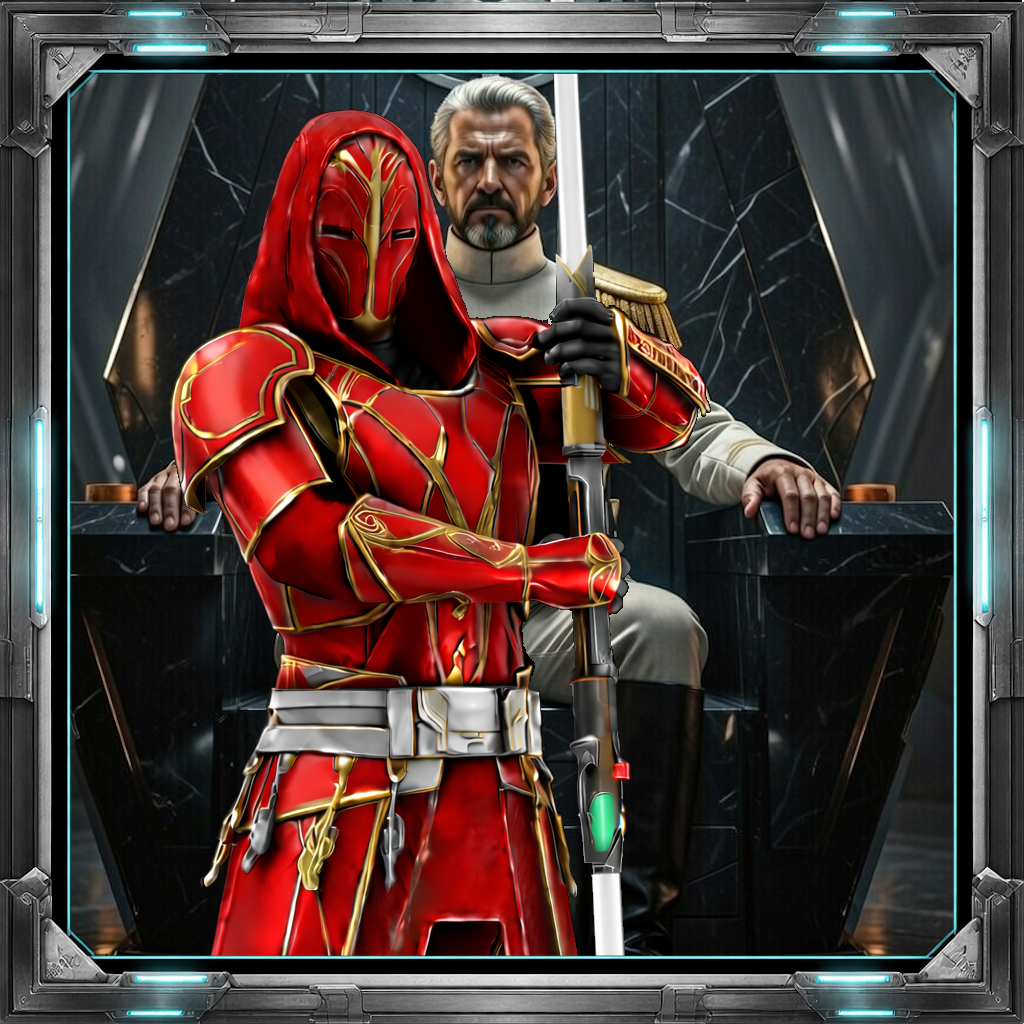
The Sovereign Protectors are the innermost protective detachment of the Imperial Throne. The order is limited to four members, each selected from among the most accomplished knights of the Imperial Order and approved personally by the Emperor. They do not replace the Imperial Guard. They serve alongside it in those circumstances where conventional protection must be joined to the abilities, perception, and spiritual discipline of the Imperial Order.
The four Protectors are distinguished by rare silver-bladed lightsabers, a privilege reserved to their office. Their blades symbolize clarity, restraint, and devotion without personal ambition. Although trained for decisive combat, the Protectors are expected to place defense above display and the Emperor’s survival above every consideration of reputation or honor.
Their duties include immediate proximity to the Emperor during exceptional threats, protection against Force-sensitive assailants, the safeguarding of sacred or strategically important Imperial sites, and missions of the highest sensitivity. Their authority derives directly from the Emperor and is exercised in coordination with the High Protector. Within an established security operation, the Sovereign Protectors and the Imperial Guard function as one protective system rather than as rival bodies.
In ceremonial dress, the Sovereign Protectors combine elements of the Imperial Order’s knightly uniform with the crimson and black insignia of the Imperial Guard. Their appearance reflects their dual identity: knights of the Imperial Order and sworn protectors of the sovereign.
The Imperial Guard consciously joins the traditions of the Republic to the institutions of the New Order. Its armor recalls the Senate Guard. Its candidates include veterans of the Coruscant Guard and other formations that defended the capital during the final years of the Republic. Its oath, however, is Imperial: service to the Emperor, the Charter, the lawful succession, and the continued stability of the Empire.
The Guard’s culture rejects the idea that proximity to the sovereign is a form of privilege. Guardsmen are expected to be disciplined, discreet, and politically restrained. They do not seek influence through access, speak publicly in the Emperor’s name, or involve themselves in ministerial rivalries. Their place near the Throne exists because they are trusted not to exploit it.
In Imperial ceremony, the crimson Guard represents continuity, vigilance, and sacrifice. In practical service, it remains what it was created to be: the final shield between the sovereign and any threat that reaches the heart of the Empire.
The Imperial Guard is presently commanded by High Protector [Name], who serves as the Emperor’s principal adviser on matters of personal, household, and palace security. The High Protector directs all Guard formations, supervises the Sovereign Protectors in their protective role, and coordinates with Imperial Intelligence, the Imperial Security Bureau, the Imperial Order, military commands, and local authorities whenever their assistance is required.
[Name] entered the Imperial Guard after distinguished service in [former branch or unit] and was appointed High Protector by Emperor Draco Tanos following [notable service or event]. Under [his/her] command, the Guard maintains constant readiness while preserving the discipline, restraint, and ceremonial dignity expected of those entrusted with the immediate defense of the Imperial Throne.