















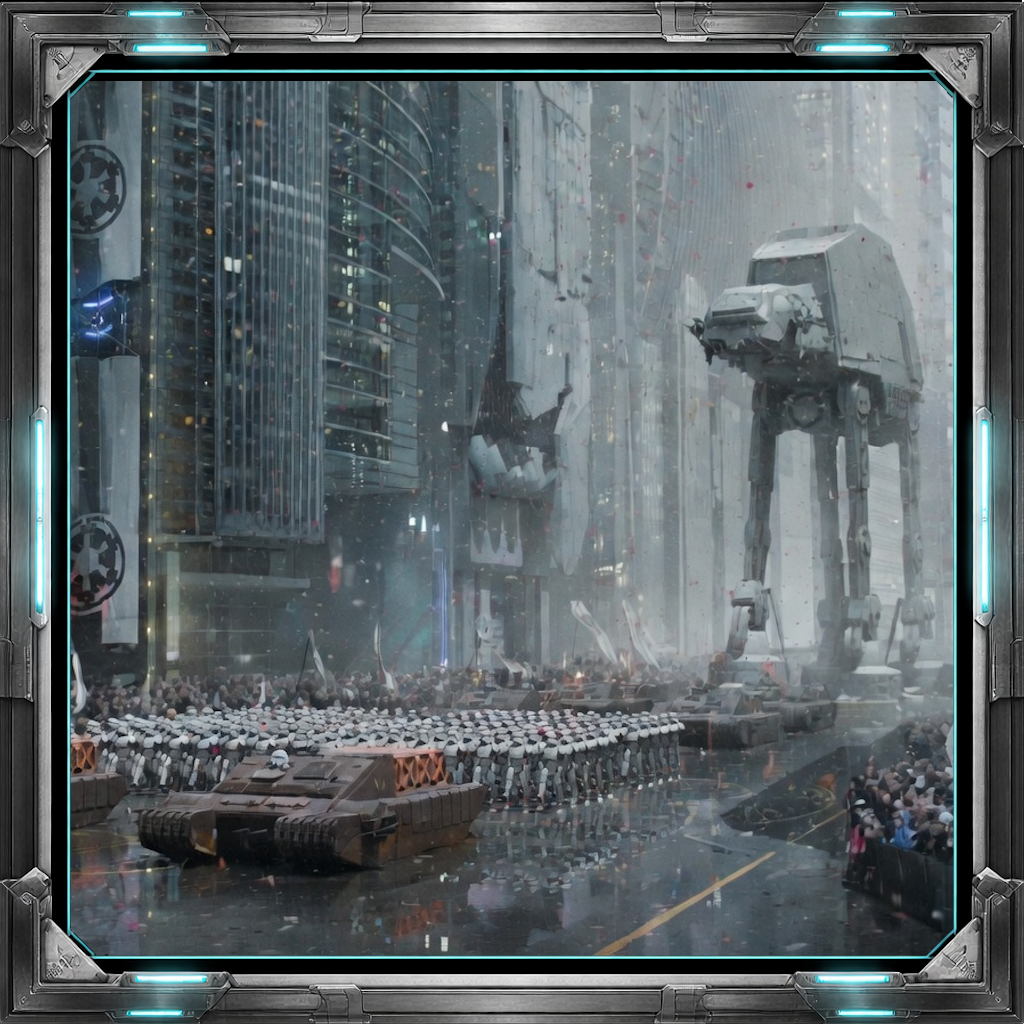
 The Ministry of War is the civilian administrative authority responsible for sustaining the Imperial Armed Forces. It manages defense budgeting, procurement, logistics, personnel, military construction, veterans affairs, mobilization and institutional readiness.
The Ministry does not command fleets or armies in battle. That authority belongs to Imperial High Command and the military chain of command. War ensures that commanders receive the personnel, materiel, infrastructure and funding required to carry out lawful operations.
Its principal institutions include Defense Logistics Command, the restored Ordnance Regional Depot system, the Directorate of Defense Procurement, the Imperial Veterans Administration and the Imperial Inspectorate.
The Ministry of War is the principal civil ministry responsible for the administration, financing, procurement, logistics, personnel systems and institutional readiness of the Imperial Armed Forces.
It does not exercise operational command in the field. Campaigns, deployments, battle plans and direct command of military formations remain the responsibility of Imperial High Command and the commanders serving beneath it.
The Ministry exists to ensure that the armed forces are properly manned, equipped, supplied, housed, transported, paid and sustained in accordance with Imperial law and the priorities established by the Imperial Throne and Ruling Council.
Its mandate extends across the Imperial Navy, Imperial Army, Stormtrooper Corps, Starfighter Corps and the common support institutions that serve more than one branch.
Imperial defense administration rests upon readiness, accountability, unity of effort, continuity of supply and lawful civilian oversight.
Military power must be supported by systems capable of functioning across sectors, regions and fronts without dependence upon improvised local arrangements.
Resources are allocated according to strategic need, not institutional rivalry or private influence.
Administrative efficiency is not pursued at the expense of combat effectiveness, troop welfare, lawful process or the preservation of essential reserves.
The Minister of War is the senior civil official responsible for the administration of Imperial defense.
The Minister reports to the Imperial Ruling Council and advises the Imperial Throne, Grand Vizier and Imperial Senate on defense appropriations, readiness, force sustainment, military construction and long-term capability requirements.
The Office of the Minister includes policy planning, legal counsel, budget administration, legislative liaison, interministerial coordination, emergency planning and direct oversight of the Ministry's principal agencies.
The Minister may issue administrative directives throughout the Ministry but may not assume operational command of military forces.
Imperial High Command directs military operations, establishes campaign objectives and commands the armed forces in war and crisis.
The Ministry of War translates operational requirements into budgets, contracts, personnel plans, infrastructure programs and logistics support.
Senior Ministry officials maintain permanent liaison with High Command so that strategic needs are understood before crises become supply failures.
Disputes over command remain within the military chain of command, while disputes over appropriations, procurement and civil administration remain within the Ministry.
The Ministry maintains senior secretaries, undersecretaries and directors for personnel, logistics, procurement, infrastructure, finance, veterans affairs, mobilization and inspection.
These officials work with the service chiefs and members of Imperial High Command without forming a parallel military chain of command.
Each branch designates administrative representatives to the Ministry for common planning, but branch interests do not override Imperial priorities.
Cross-service offices are used where common systems are more efficient than separate institutions.
The Ministry of War consists of the Office of the Minister, senior defense secretariats and directorates for personnel, procurement, logistics, construction, mobilization and veterans affairs.
Its principal organizations include Defense Logistics Command, the Ordnance Regional Depot system, the Directorate of Defense Procurement, the Directorate of Military Construction, the Imperial Veterans Administration and the Imperial Inspectorate.
Regional and branch liaison offices connect Ministry administration with sector commands, fleets, armies and service headquarters.
The Ministry's success is measured not by ceremonial size but by whether Imperial forces are ready, supplied, accountable and capable when called upon.
The Ministry prepares the unified defense budget and submits it through the established constitutional process.
Appropriations cover personnel costs, procurement, maintenance, construction, logistics, pensions, medical support, readiness and reserve requirements.
The Ministry of Finance reviews revenue capacity and fiscal compliance, while War determines military necessity in consultation with High Command.
All major programs are subject to cost control, milestone review and audit.
The Directorate of Military Personnel administers service records, assignments policy, pay status, promotions administration, retirement processing and personnel accountability.
Each branch retains professional authority over qualifications and career standards, while the Ministry maintains the common administrative framework.
Personnel records must accurately reflect service history, rank, specialty, decorations, discipline and eligibility for benefits.
Fraudulent appointments, falsified records and unlawful favoritism are referred for investigation.
The Ministry coordinates recruiting standards, enlistment contracts, aptitude screening and accession quotas for the Imperial Armed Forces.
Recruiting offices operate in cooperation with branch authorities and regional governments.
The Stormtrooper Corps maintains its own force-generation system where clone personnel are concerned, while administrative support, records and sustainment remain coordinated through War.
Recruitment policy must reflect actual force requirements rather than ceremonial targets or inflated reporting.
The Ministry administers military pay systems, duty allowances, family support, quarters standards and housing programs.
Rates are coordinated with Finance and reviewed according to rank, duty, location, hazard and service conditions.
Commanders may certify duty status but may not alter compensation records for personal or political purposes.
Failures in pay or housing are treated as readiness issues because they directly affect morale and retention.
The Ministry maintains the administrative systems through which promotions, commissions, appointments, retirements and decorations are recorded and published.
Professional recommendations originate within the military chain of command.
The Ministry verifies legal authority, eligibility, vacancies and documentary accuracy before action is finalized.
Decorations must correspond to documented service and may not be distributed merely as patronage.
The Directorate of Defense Procurement acquires weapons, starships, vehicles, armor, communications systems, munitions, uniforms and other materiel required by the armed forces.
Procurement is conducted through competitive bidding, negotiated contracts, state arsenals or direct Imperial production according to strategic need.
The Directorate works with industry but does not permit private suppliers to dictate Imperial force structure.
Major contracts include performance standards, delivery schedules, inspection rights, penalties and provisions for wartime expansion.
High Command and the armed services define operational needs, while the Ministry converts those needs into formal acquisition programs.
Before approval, programs are reviewed for necessity, affordability, interoperability, sustainment cost and industrial capacity.
Duplicative systems may be rejected where a common platform can serve multiple branches.
Urgent wartime needs may receive accelerated approval, but emergency authority does not eliminate later audit.
Defense Logistics Command is the Ministry's principal common-support organization for military supply and distribution.
It coordinates food, fuel, uniforms, ammunition, medical supplies, spare parts, common vehicles and other materiel used across more than one branch.
Branch logistics organizations remain responsible for tactical distribution and specialized service requirements.
Defense Logistics Command maintains strategic reserves, depot networks, inventory standards and interservice movement priorities.
The Ministry has restored and modernized the Ordnance Regional Depot system, commonly known as the ORD network.
ORD facilities store, repair, issue and redistribute weapons, vehicles, ammunition, spare parts and other military supplies throughout Imperial space.
Depots are positioned to support sectors, oversectors, major fleets, armies and frontier commands without requiring every shipment to originate from the Core.
Each depot maintains security, inventory accountability, emergency stock levels and the capacity to expand during mobilization.
ORD commanders maintain accurate inventories, preservation programs, maintenance cycles and controlled access.
Strategic reserves are rotated so that supplies remain serviceable rather than becoming obsolete in storage.
No commander may treat depot stocks as personal property or divert them to favored units without lawful authority.
Emergency release procedures permit rapid issue during invasion, disaster or major military deployment.
The Ministry manages contracts, warehouses, transport schedules, inventory systems and distribution plans required to sustain military operations.
Supply chains are designed with redundancy so that the failure of a single world, route or supplier does not paralyze an entire command.
Critical materials receive priority protection and alternate-source planning.
Supply officers must report shortages honestly so that deficiencies can be corrected before they become battlefield failures.
The Ministry plans the strategic movement of personnel, equipment and supplies in cooperation with Imperial High Command and the Ministry of Transportation.
War determines military priority and cargo requirements. Transportation manages civilian infrastructure, common traffic systems and coordinated route access.
Military transport commands remain within the armed forces where direct operational control is necessary.
Commercial carriers may support military movement under contract or lawful requisition.
The Ministry establishes maintenance policies, inspection cycles and supply standards for major classes of military equipment.
Each branch performs tactical and routine maintenance, while depots and arsenals conduct major overhaul and reconstruction.
Readiness reports must distinguish equipment that is operational, restricted, awaiting repair or beyond economical recovery.
False readiness reporting is treated as a serious administrative offense.
The Directorate of Military Construction plans and oversees bases, shipyards, depots, hospitals, training ranges, command centers, housing and logistics hubs.
Projects are reviewed for strategic necessity, security, sustainability and long-term maintenance.
Construction may be performed by military engineers, Imperial works organizations or contracted industry.
Facilities are not considered complete until communications, utilities, defenses, housing and supply support are functional.
The Ministry administers military shipyard funding, capacity planning, modernization and production priorities.
Operational control of commissioned vessels remains with the Navy, while the Ministry ensures that construction, repair and refit capacity meet approved plans.
Arsenals manufacture, assemble, test and store military equipment under strict safety and security standards.
Industrial concentration is balanced against the need for regional resilience and wartime redundancy.
The Ministry prepares plans for wartime expansion, reserve activation, industrial conversion, emergency procurement and rapid force sustainment.
Mobilization plans are coordinated with High Command, Finance, Commerce, Transportation, Energy, Health and Interior.
Plans identify critical labor, materials, transport routes and facilities before a crisis occurs.
Emergency measures are reviewed regularly so that outdated assumptions do not become official doctrine.
The Ministry maintains the administrative systems for reserve personnel, retired specialists subject to recall and designated auxiliary support units.
Branches determine military readiness standards, while War maintains rosters, benefits, mobilization notices and equipment plans.
Reserve formations must receive realistic training and cannot exist merely as paper units.
Recall authority is exercised according to law and the scale of the emergency.
The Ministry coordinates Imperial civil-defense planning where military attack, invasion or strategic disruption threatens essential government and infrastructure.
Interior remains responsible for civil administration, while War provides threat assessments, military coordination and support for defense measures.
Plans may include shelters, evacuation corridors, continuity sites, protected communications, emergency stockpiles and infrastructure hardening.
Civil-defense authority does not convert ordinary civilian government into military rule.
The Ministry coordinates military medical requirements with the Ministry of Health.
Health establishes professional, clinical and public-health standards, while War funds, deploys and sustains military medical units in support of the armed forces.
Medical personnel serving in military formations remain subject to the lawful command structures applicable to their assignments.
Long-term care, rehabilitation and veteran medical services are coordinated through the Veterans Administration.
The Imperial Veterans Administration provides pensions, transition assistance, disability support, rehabilitation, survivor benefits and recognition for former members of the armed forces.
Eligibility and benefits are based upon lawful service records and applicable statutes.
The Administration coordinates medical services with Health and employment programs with Labor or other appropriate civil authorities.
Veterans are not discarded once their active service ends, and the state retains obligations created by lawful military service.
The Ministry administers survivor benefits, casualty notification support, family assistance and housing protections connected to military service.
Families of deployed or fallen personnel must receive accurate information and timely administrative decisions.
Commanders may assist families but may not substitute informal promises for statutory benefits.
Disputes are subject to administrative review and, where appropriate, judicial appeal.
The Imperial Inspectorate is a specialized agency of the Ministry of War charged with preserving discipline, efficiency, loyalty, combat readiness and fiscal integrity throughout the Imperial Armed Forces. It serves as the Ministry's principal instrument for examining whether military formations and the vast administrative establishment supporting them remain effective, accountable and faithful to Imperial law and the principles of the New Order.
Its jurisdiction extends across the Imperial Navy, Imperial Army, Stormtrooper Corps and Starfighter Corps, as well as military installations, headquarters, depots, arsenals, shipyards, procurement offices and other defense-support organizations. Inspectors may examine operations, personnel practices, training records, maintenance standards, supply accounts, contracts and financial records wherever they bear upon military readiness or the responsible use of Imperial resources.
The Inspectorate reports directly to the Minister of War and remains institutionally independent of the commanders and administrative offices it inspects. This independence permits its personnel to follow evidence across branch and regional boundaries without allowing rank, patronage or local influence to suppress an unfavorable finding.
The Inspectorate is both corrective and preventive. It identifies corruption, waste, dereliction and systemic weakness, but also requires remedial plans, monitors their implementation and returns for reinspection when necessary. Its purpose is not merely to assign blame after a failure, but to expose conditions that could endanger Imperial forces before they produce defeat, loss of life or the diversion of state resources.
The Inspectorate is headquartered at Imperial Inspectorate Headquarters on Coruscant, formerly the Republic Center for Military Operations and later the headquarters of Naval Intelligence. From this central headquarters, the Inspector General directs a galaxy-wide network of regional and field offices capable of dispatching inspection teams to fleets, armies, bases, shipyards and military-industrial facilities throughout Imperial space.
Its personnel are selected from experienced and demonstrably loyal officers and civil officials drawn from across the armed forces and defense administration. Operational inspectors, readiness specialists, auditors, logisticians, engineers and procurement examiners are organized into teams suited to the institution or matter under review. Mixed teams may be used when an inspection crosses service or technical boundaries.
Inspectors operate under written commissions granting access to relevant military facilities, records, personnel and materiel. Commanders and Ministry officials are required to cooperate with a lawful inspection and to preserve requested records. Obstruction, concealment, retaliation against witnesses and the deliberate falsification of readiness or financial reports are themselves grounds for adverse findings and referral.
The Inspectorate may compel corrective action within its administrative jurisdiction and may recommend financial sanctions, suspension of contracts, relief of command, disciplinary proceedings or investigation by another competent authority. It does not itself exercise battlefield command, adjudicate courts-martial or function as a general police or intelligence service.
Inspectorate teams conduct both scheduled and unannounced inspections of Army, Navy, Stormtrooper and Starfighter Corps formations. Unannounced inspections are used where advance notice could permit records, inventories or local conditions to be temporarily manipulated.
Operational reviews evaluate combat readiness, command effectiveness, discipline, training, maintenance, safety, personnel administration and the condition of assigned weapons, vessels and vehicles. Inspectors compare official reports against physical inventories, duty rosters, maintenance logs, exercise results and the testimony of personnel at multiple levels of command.
The Inspectorate also investigates credible reports of inefficiency, dereliction of duty, disloyalty or serious administrative irregularity when those matters fall within its mandate. Findings involving espionage, organized subversion or criminal conduct are preserved and referred to the proper security, intelligence or judicial authority.
At the conclusion of a review, inspectors issue formal findings and may require a corrective-action plan, order follow-up reporting or schedule reinspection. Serious failures may support recommendations for relief of command, disciplinary proceedings or broader examination of an entire command system. Findings must be evidence-based and cannot be altered merely to protect a favored commander.
The Inspectorate conducts thorough audits of military budgets, payroll, procurement accounts, supply chains, depot inventories, construction programs and other defense expenditures. Auditors trace appropriated funds and materiel from authorization through delivery and use, allowing discrepancies to be identified across multiple offices or worlds.
Audits seek to prevent and expose waste, fraud, corruption, false billing, diversion, unauthorized expenditure and systemic weaknesses in financial control. They also determine whether resources have been assigned according to approved military priorities rather than personal influence or the convenience of contractors.
Where losses result from poor administration, the Inspectorate may require revised controls, recovery plans and renewed audit. Evidence of deliberate theft, bribery, falsification or conspiracy is secured and referred to Finance, Justice or the appropriate investigative body for civil, military or criminal action.
Financial inspection is therefore not limited to balancing accounts. It protects military readiness by ensuring that credits, equipment and supplies authorized for Imperial forces actually reach the formations for which they were intended.
Major acquisitions are reviewed for contract compliance, testing integrity, delivery performance and conflicts of interest.
Inspectors may examine contractors, subcontractors and military officials involved in acquisition decisions.
Evidence of bribery, collusion, sabotage or deliberate falsification is referred to the proper investigative authority.
Administrative failure and criminal conduct are distinguished so that each receives the correct response.
The Ministry supports discipline through lawful personnel systems, accurate records, inspection and enforcement of administrative standards.
Military justice itself remains governed by the applicable military legal system and command authorities.
The Inspectorate may recommend disciplinary action but does not replace courts, commanders or prosecuting authorities.
Administrative penalties must be documented and reviewable.
The Ministry works with Finance on appropriations, Transportation on strategic movement, Commerce on defense industry, Science on capability development, Education on academies and Health on military medicine.
It coordinates with Interior on mobilization and civil defense, Security and Justice on unlawful activity and the Imperial Throne and Ruling Council on national policy. These relationships preserve each institution's lawful jurisdiction while ensuring that the armed forces receive coherent support across the Imperial Government.
The Ministry of War does not exercise general authority over Imperial Intelligence, Naval Intelligence or the Imperial Security Bureau.
Intelligence agencies may provide threat assessments or investigate matters affecting procurement, sabotage, espionage or loyalty.
The Ministry provides records and cooperation under lawful authority but does not direct intelligence operations.
Operational security remains essential, but secrecy cannot be used to conceal ordinary waste or corruption.
The Imperial academy system falls under the Ministry of Education.
War defines military training requirements, occupational needs and commissioning standards in consultation with the armed services.
Education administers academies, curricula, faculty systems and academic accreditation, while operational field training remains under the appropriate military branch.
This division preserves professional educational standards without removing the armed forces from determining what competencies they require.
The Ministry of Science conducts military research and scientific development within its own constitutional remit.
War identifies capability needs, operational requirements and procurement priorities but does not duplicate the scientific establishment.
Once systems are ready for acquisition, War oversees testing for military suitability, contracting, production and sustainment.
Research independence and procurement accountability are preserved by keeping their functions distinct.
Commerce regulates private industry, markets and commercial conduct, while War procures military goods and manages defense contracts.
Industrial policy affecting strategic production is coordinated between the ministries.
War may establish security, quality and delivery requirements without assuming general control of civilian markets.
Contractors remain subject to Imperial commercial law as well as defense-specific obligations.
Finance establishes fiscal policy, revenue controls and government-wide accounting standards.
War prepares and administers the defense budget within those standards.
Neither ministry may unilaterally erase the other's lawful responsibilities: military necessity requires funding, while funding requires accountability.
Joint review is required for major emergency appropriations and long-term capital programs.
Transportation administers civilian routes, ports, traffic systems and common transit infrastructure.
War determines military mobility priorities and operates military transportation commands where direct control is required.
The ministries coordinate route access, emergency movement, port capacity and infrastructure protection.
Military priority is exercised with regard for safety and the continued functioning of essential civil traffic.
Health establishes professional medical, pharmaceutical and public-health standards applicable to military care.
War provides military facilities, deployment support, logistics and personnel administration.
Joint planning covers casualty evacuation, epidemic control, rehabilitation and veteran care.
Clinical standards may not be lowered solely for administrative convenience.
Interior remains responsible for civil administration, emergency governance and the continuity of essential civilian institutions.
War provides military threat assessments, defense requirements and support when invasion or strategic disruption exceeds ordinary civil capacity.
The ministries coordinate mobilization measures, evacuation planning, protected communications, emergency stockpiles and infrastructure hardening.
This cooperation does not place ordinary civil government under military command or permit either ministry to displace the other's lawful authority.
Security investigates criminal activity affecting defense administration, while Justice prosecutes offenses within its jurisdiction.
The Ministry and Inspectorate preserve records, report suspected violations and cooperate with lawful inquiries.
War does not maintain a separate general intelligence or police empire.
Military discipline, civil criminal law and administrative accountability remain distinct but coordinated.
Prepared in peace, the Ministry ensures that the Empire can act decisively in war.