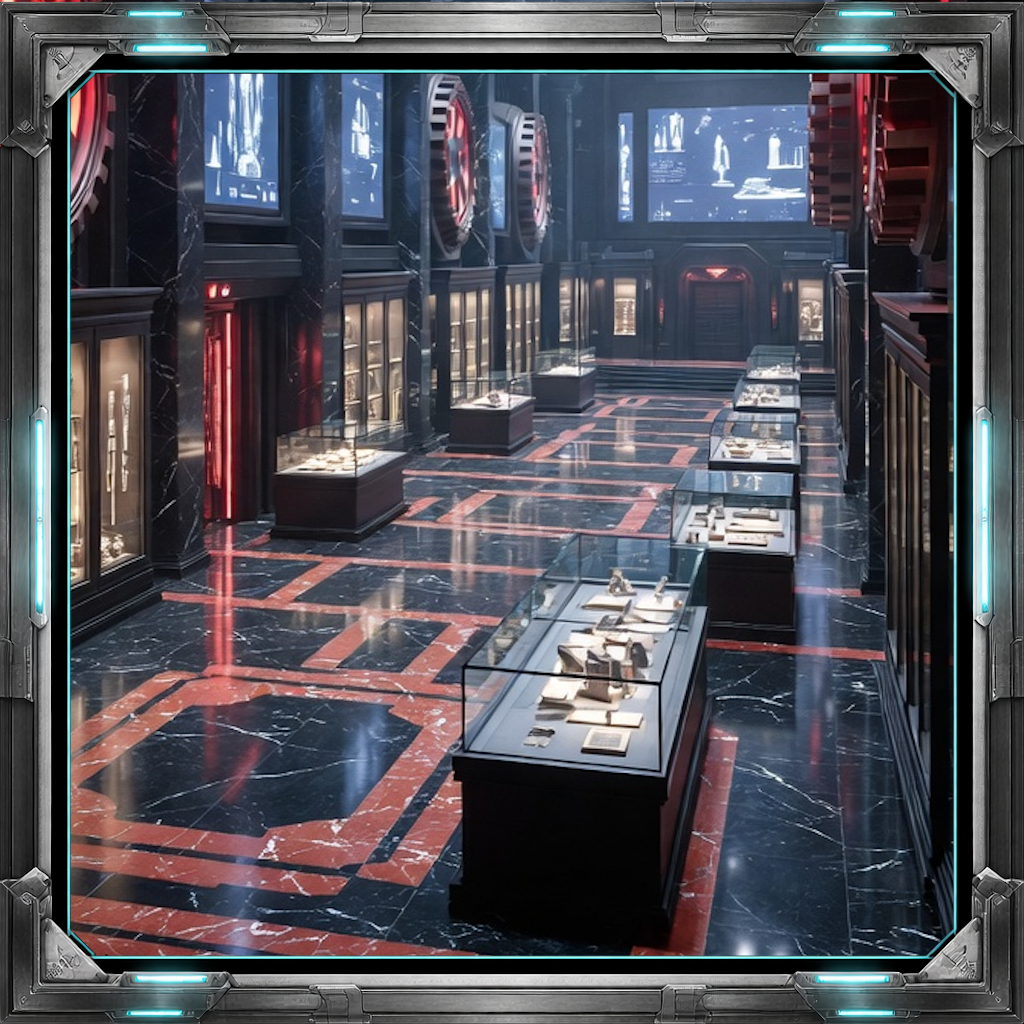



The Ministry of Antiquities is the principal Imperial authority responsible for preserving, studying and protecting the historical inheritance of the galaxy. Its jurisdiction extends across archaeological sites, monuments, museums, archives, relics, historic battlefields, ancient structures and other places or objects judged to possess enduring significance.
Unlike the Ministry of Culture, which concerns itself primarily with living traditions, artistic life and the continuing cultural development of Imperial society, the Ministry of Antiquities safeguards the civilizations, institutions and events of the past. It works with planetary governments, universities, museums, research institutes and other Imperial bodies to ensure that significant discoveries are neither neglected nor exploited.
The Ministry does not presume that every object of value belongs on Coruscant. Its policy is preservation first. Ancient cities, ruins and landscapes are ordinarily protected where they stand, while portable relics, statuary and recovered materials may be moved when local conditions cannot reasonably guarantee their safety, conservation or lawful stewardship.
The Ministry acts under the authority of the Imperial Government to identify, document, preserve and interpret sites, records and objects of exceptional historical importance. The Minister of Antiquities is appointed by the Emperor and sits within the civil administration represented on the Imperial Ruling Council.
Its mission is to protect the material record of galactic civilization, support responsible scholarship and ensure that future generations inherit an accurate understanding of the past. To that end, the Ministry establishes standards for excavation, conservation, restoration, museum administration, archival preservation and the lawful transfer of antiquities.
Local governments retain custody of many regional institutions and historic properties. The Ministry intervenes directly when a matter possesses broad Imperial significance, crosses sector boundaries, involves endangered material or exceeds the technical or security capacity of local authorities.
The Ministry licenses and supervises archaeological work throughout Imperial territory. Excavations may be conducted by the Imperial Archaeological Service, by accredited universities and museums, or by qualified private institutions operating under an approved permit.
Field teams commonly include archaeologists, historians, anthropologists, engineers, conservators, linguists and specialists from the Ministry of Science. Their work emphasizes careful documentation, controlled excavation and minimal unnecessary disturbance. Recovery for its own sake is discouraged; the context of a discovery is considered as important as the object itself.
Unauthorized excavation, looting, trafficking in protected antiquities and deliberate damage to registered sites fall within the Ministry's enforcement remit and may be referred to the Ministry of Justice, Imperial Customs or the Judicial Department as appropriate.
The Ministry protects places associated with significant events, persons, institutions and civilizations. These may include ancient settlements, temples, civic buildings, monuments, archaeological reserves, historic battlefields, wrecks, preserved starships, industrial sites and structures of exceptional architectural or scientific value.
Preservation in place is preferred whenever practical. An ancient city is not dismantled merely because it is difficult to protect, nor is a battlefield stripped of every surviving trace for the convenience of an off-world collection. Instead, the Ministry may fund local security, stabilization, controlled access, environmental shielding or conservation works.
Where portable objects face theft, war, environmental collapse, neglect or irreversible deterioration, the Ministry may arrange temporary or permanent removal to a secure local, sector or Imperial repository. Such decisions are based upon risk, significance, available facilities and the possibility of later return.
The Ministry directly administers the principal state-owned Imperial museums and collections. These institutions serve as repositories, research centres and places of public education, presenting the history of the Republic, the Empire and the many civilizations that preceded both.
Most local museums remain under planetary, sector, academic or private administration. The Ministry nevertheless exercises considerable influence through accreditation, conservation grants, professional standards, traveling exhibitions and access to Imperial collections. Institutions receiving Imperial recognition are expected to maintain suitable security, accurate interpretation and proper conditions for preservation.
The Ministry of Culture commonly assists with exhibition programming and public interpretation, while the Ministry of Tourism may support visitor access and promotion. Custody of an artifact, however, remains a separate question from how it is displayed or incorporated into civic life.
The Ministry maintains archives containing records of lasting historical value. These include constitutional instruments, treaties, exploration logs, official correspondence, military histories, notable personal papers, technical records of major discoveries and surviving documentation from extinct or displaced governments.
It does not control every archive in the Empire. Ministries and agencies retain active administrative records required for their own operations, while military, judicial, intelligence and local archives remain under their respective authorities unless formally transferred. The Ministry's role begins when records are judged to possess enduring historical importance beyond their original administrative purpose.
Access may be restricted where records remain classified, endanger living persons, reveal sensitive technology or otherwise threaten Imperial security. Restricted records are preserved rather than destroyed merely for being inconvenient.
The Bureau of Ancient Languages employs specialists in extinct, endangered and archaic languages from throughout the galaxy. Its scholars decipher inscriptions, reconstruct damaged texts, preserve rare writing systems and assist expeditions in interpreting newly discovered records.
The Ministry also supports historical, archaeological and conservation scholarship through grants, fellowships and partnerships with Imperial academies and universities. Experts may be seconded to the Ministry of Education, the Ministry of Science, the Ministry of Culture or the Imperial Order when their knowledge is required.
Objects recovered during excavation or lawful transfer are cataloged, assessed and stabilized before being returned, deposited or displayed. Conservation laboratories examine composition, age, condition and provenance while documenting every intervention made to an object.
The Ministry distinguishes stewardship from ownership. An artifact of primarily local importance may remain in a planetary museum; one of sector-wide significance may be entrusted to a regional institution; and one of exceptional galactic importance may be placed within an Imperial collection. Security and preservation are decisive considerations, not prestige alone.
Relics, statues and other portable works may be relocated when reasonable protective measures cannot safeguard them where found. Monumental structures, ancient cities and entire landscapes are instead preserved through site management, legal protection and specialized conservation.
The Ministry possesses extensive expertise in the archaeology and history of the Jedi Order, the Sith and other Force traditions. Such knowledge is essential to identifying sites, interpreting texts and placing recovered objects within their proper historical context.
Force-related discoveries are handled in close cooperation with the Imperial Order. Antiquities specialists remain responsible for provenance, documentation, conservation and historical interpretation, while the Imperial Order evaluates unusual properties, religious significance and possible hazards.
The Ministry is not officially an intelligence service, nor does it independently conduct covert operations. Nevertheless, the discovery of a dangerous or politically sensitive relic may require secure recovery, controlled transport or discreet interagency action. In such cases, the Ministry supplies the necessary historical and technical expertise while the competent security authority directs the operation.
The Imperial Register of Historic Places records sites, monuments, structures, vessels, archives and objects formally recognized as possessing exceptional historical significance. Registration confers legal protection, access to preservation funding and eligibility for specialist assistance.
Designation does not automatically transfer ownership or administration to the Imperial Government. Planetary and sector authorities may continue to manage a registered property under Ministry standards. Direct Imperial administration is reserved for state-owned institutions, sites of exceptional galactic importance or cases in which local stewardship has demonstrably failed.
Registered properties may be classified as Imperial Historic Sites, Imperial Archaeological Reserves, Imperial Heritage Monuments, Imperial Cultural Landmarks or Imperial Historical Archives according to their nature and significance.
The Ministry is divided into specialized agencies and professional services, including:
Sector and oversector offices coordinate local work, provide technical assistance and report significant discoveries to the central ministry. Major expeditions may be organized jointly with universities, sector governments or other ministries.
The Ministry works closely with the Ministry of Culture on exhibitions, public interpretation and artistic heritage; with the Ministry of Tourism on access to historic destinations; with the Ministry of Science on dating, materials analysis and conservation technology; and with the Ministry of Education on curricula, research and public scholarship.
It also cooperates with the Ministry of Interior on customs controls, territorial administration and protected landscapes; with the Ministry of Justice and the Judicial Department on trafficking and looting; and with COMPNOR's Art Group and related cultural bodies where public programming overlaps with historical preservation.
The Ministry's relationship with the Imperial Order is especially important whenever discoveries involve Force traditions, active relics or sacred sites requiring expertise beyond ordinary archaeological practice.
The Ministry of Antiquities serves as the guardian of civilization's collective memory. Its work ensures that the Empire does not merely inherit the past, but understands and preserves it.